

Bridges at Caring Dental
Bridging gaps between natural teeth
Dental bridges can be a good option if you have one or more missing teeth, providing a natural-looking replacement that restores chewing function and enhances appearance. Importantly, bridges also provide vital support for the surrounding teeth, preventing movement and alignment issues.
What is a dental bridge?
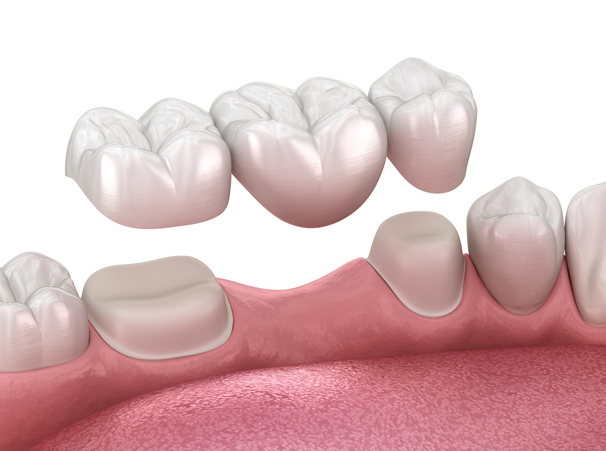
- Dental bridges are artificial teeth placed into gaps and attached to the natural teeth on each side, or to a single adjacent tooth (a cantilever). They can also be a combination of multiple teeth and span across more than one gap.
- Bridges are usually made from high-quality ceramic, matched to your surrounding teeth, and because they are fixed in place you can look forward to eating, speaking and smiling with confidence!
- In certain situations it may be preferable to replace a gap with an adhesive or ‘Maryland’ bridge, which usually has metal wings that are resin-bonded to the back of the adjacent teeth. More often, a conventional bridge is used, where the adjacent natural teeth are shaped and covered with custom-made crowns, providing strong ‘abutments’ to support the artificial tooth (known as a ‘pontic’).
3 steps to a beautiful bridge
1. Consultation
Your dentist will discuss all the options with you for replacing a gap, explaining the merits and suitability of each. The adjacent teeth will be assessed to ensure they are healthy enough and sufficiently strong to support a bridge and provide a lasting solution. X-rays may also be taken to ensure the roots and supporting bone are also healthy and strong.
2. Preparation
The supporting tooth or teeth will be prepared and, if necessary, we will also repair or replace any fillings and other restorations to ensure they are as strong and sound as possible. Next, using our state-of-the-art 3D scanner, an accurate record of your teeth shape and shade is sent electronically to the laboratory, to custom-make a perfectly matched bridge. In the meantime, if it is a conventional type, a temporary bridge or crowns will be placed.
3. Fitting
Approximately two weeks later you return to have your new, permanent bridge fitted. At this stage you’ll be able to see and feel the bridge in place, to ensure you are happy with the look and fit. Only once you are completely satisfied, the bridge will be permanently fitted. Your dentist will show you how to clean and care for your bridge, and at subsequent appointments we will check that you are pleased with its performance, and that it’s in good condition.
Bridges vs dental implants
While dental implants are an increasingly popular and modern solution for missing teeth, they are not always suitable, for example if there is insufficient bone density, or due to certain health issues (see FAQs below). There are some situations where a bridge is preferred, and they can certainly be quicker and more affordable, too.
However, bridges do require alterations to healthy teeth, and may not provide the same level of stability as implants, which are firmly attached to the bone in your jaw. Another drawback is that bridges do not stimulate the jawbone, which over time can lead to bone loss beneath the bridge (or a dental gap).
Your dentist will be happy to discuss these considerations with you. However, it is almost always preferable to replace missing teeth than to leave a gap, which can also lead to bone loss and other issues (see FAQ, below).

Bridges FAQs
Because teeth support each other, and work together, it is usually beneficial to replace any missing teeth. Gaps can cause unwanted movement of the remaining teeth, and bone loss in the jaw. These issues can lead to changes in your bite, your ability to chew normally, and new gaps which lead to food trapping, increasing the chances of decay. Gaps can also lead to gum inflammation, infection, and potential bone loss.
Sometimes, a dental implant might not be the best choice if there isn’t enough strong bone in the jaw to support it and the patient chooses not to go ahead with more advanced treatment to rebuild the bone. Certain health conditions, such as poorly controlled diabetes, can also affect the healing of implants. Smokers and heavy drinkers are also at greater risk of complications and we may advise against implants in such cases. Your dentist will invite you to discuss any health issues as part of their comprehensive assessment, so that an informed and safe decision can be made. You can find out find out more on our dental implants page.
Do you have missing or loose teeth?
If you have missing teeth, and would like to restore your smile, our dentists would be pleased to see you for an initial assessment and to discuss suitable treatment options with you. We will always endeavour to give you the best possible care to suit your needs and budget.
Interest-free payments
If you would like to spread the cost of your treatment, find out more about our interest-free payment option. Our friendly reception team will be happy to help if you have questions or need assistance completing the application.
Book an appointment today
Contact us or book online to keep your teeth healthy